Why a Dog Gets a Bloated Belly After Eating
Medically reviewed by Karen Turner-Knarr, DVM, CVA, CVFT, CVCH — For general education — not a substitute for veterinary care.
A dog's belly swells after eating for reasons ranging from a fast dinner to a true emergency, and the difference matters within the hour.
On this page
- Start with the scary version, because it’s the one you can’t afford to miss
- Myth: a round belly after a meal always means trouble
- A case that still shapes how I ask questions
- What’s actually happening in there
- When the underlying issue is something like EPI
- A tradeoff I’ve had to walk owners back from
- What to actually do
Start with the scary version, because it’s the one you can’t afford to miss
A dog’s stomach can fill with gas after a meal for a boring reason or a life-threatening one, and on physical exam the two often look the same. That’s the uncomfortable truth behind this question. A firm, drum-tight belly, unproductive retching, restlessness, and pale gums point toward gastric dilatation-volvulus, or GDV — the stomach fills with gas or fluid and then rotates on itself, sealing off both ends, according to VCA Animal Hospitals. Large, deep-chested dogs — Great Danes, German Shepherds, Standard Poodles — carry the highest risk, especially if they eat one big meal fast and then run around the yard. If your dog fits that profile and looks distended, off, or is retching without producing anything, this is not a wait-and-see situation. Call an emergency vet.
Most bellies that swell after dinner are not that. But you won’t know which kind you’re looking at just by staring at it, so the rest of this guide is about sorting the two apart and knowing what to actually do next.
Myth: a round belly after a meal always means trouble
It doesn’t. A dog who just ate a normal-sized meal, especially a food with some volume to it (kibble that expands with water, a meal with pumpkin or other fiber mixed in), will look a little fuller for an hour or two. That’s mechanical stretch, not pathology. I think in TCVM terms here as much as western ones: a Spleen Qi pattern — a dog that’s a slow, inefficient digester — often shows up as a puffy, gassy look after eating paired with soft stool or a dull coat, rather than acute pain. On the western side, that same dog might just have mild dysbiosis or a diet that’s fermenting a bit too enthusiastically in the colon. Neither picture needs a trip to the ER. What it needs is a look at feeding pace, meal size, and gut support.
Where the myth gets dangerous is when owners apply that “it’s probably nothing” reflex to a dog who is actually retching, drooling, pacing, or won’t lie down. That’s a different animal, literally and figuratively.
A case that still shapes how I ask questions
A 6-year-old Labrador, 78 pounds, came in because his owner said “his stomach looks bigger every night after dinner.” No retching, no pain on palpation, normal energy. We talked through his routine: one large meal a day, wolfed down in under two minutes, then straight outside to play fetch. By day 3 of switching him to two smaller meals with a slow-feeder bowl and a 30-minute rest period before exercise, the visible distention was gone. Nothing about that case proves anything in general — it’s one dog — but it’s the pattern I ask about first now: meal size, eating speed, and post-meal activity, because those three variables explain a large share of “why does my dog look bloated after eating” questions that turn out to be nothing sinister.
What’s actually happening in there
A few mechanisms explain most non-emergency bloating:
- Aerophagia — dogs that gulp food or water swallow air along with it, and that air has to go somewhere before it works its way out.
- Fermentation — a diet that’s mismatched to the dog’s gut, or a recent food switch, can leave undigested material for bacteria to ferment, producing gas.
- Slow gastric emptying — some dogs, often older ones or breeds prone to sensitive stomachs, move food through more slowly, so the stomach stays fuller-looking longer.
- Fiber and digestive support — pumpkin fiber is a gentle, natural source of both soluble and insoluble fiber, per Boops Pets’ vet-reviewed claim list, and can help regulate transit time and stool form in dogs whose bloating traces back to erratic digestion.
None of that is exotic. It’s mostly plumbing and pacing.
When the underlying issue is something like EPI
Occasionally a persistently bloated-looking belly, especially with weight loss, greasy stool, or a ravenous appetite that doesn’t translate into weight gain, points toward exocrine pancreatic insufficiency. EPI is treated by pancreatic enzyme replacement therapy, nutritional management (low-residue diets with moderate fat content), and supplementation of cobalamin, according to a review published via JAVMA. That same review notes that future studies are needed to further understand the causes of persistent dysbiosis in animals with EPI following initiation of pancreatic enzyme replacement therapy and assess the efficacy of treatments to ameliorate these abnormalities — which is a fair reminder that even a diagnosed, treated dog can still carry gut imbalance that needs separate attention. This isn’t a self-diagnose-at-home condition; it needs bloodwork and a vet.
A tradeoff I’ve had to walk owners back from
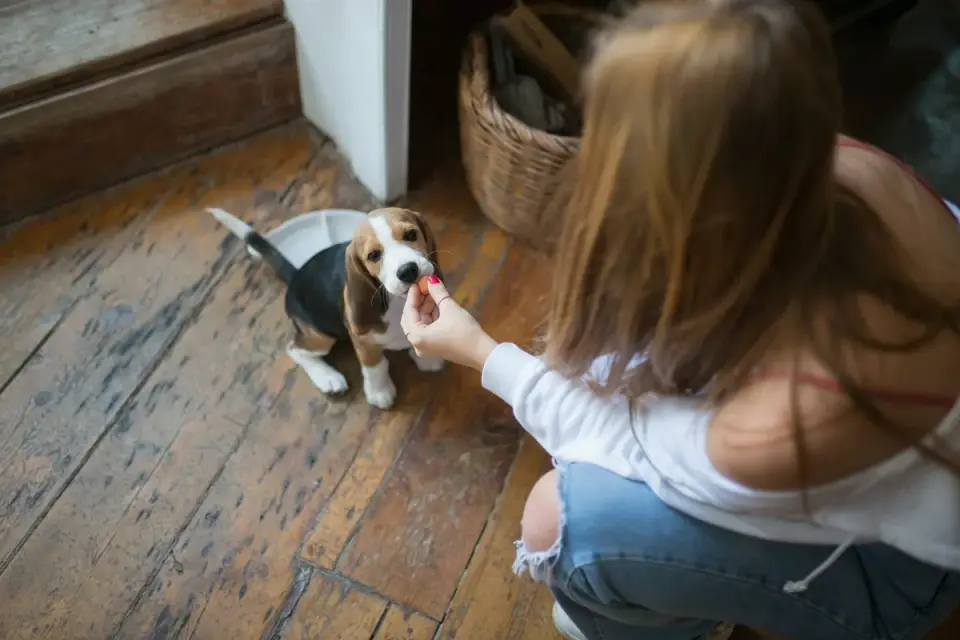
I had an owner try to fix her senior dog’s after-meal bloating entirely with a probiotic chew, skipping the conversation about meal size and feeding speed altogether. The dog, a 9-year-old Beagle at 24 pounds, seemed a little better within two weeks on paper — softer stool, slightly less gas — but the visible belly distention after dinner barely changed, because the actual driver was that she was still eating her whole ration in ninety seconds. A supplement may help support digestive balance, but it can’t out-perform a feeding pattern that’s working against it. I’ve learned to ask about eating speed before I ask about supplements, not after.
What to actually do
- Rule out emergency signs first. Firm/distended abdomen, unproductive retching, drooling, restlessness, pale gums, collapse — any of these means an emergency vet visit now, not tomorrow. Risk factors include eating one large meal daily, eating too quickly, exercising soon after meals, and a family history of the condition, per Cornell University College of Veterinary Medicine.
- Slow the meal down. A slow-feeder bowl or splitting one large meal into two smaller ones addresses aerophagia and gastric stretch directly.
- Rest before and after exercise. Avoid vigorous play in the 30-60 minutes surrounding a meal, particularly in large, deep-chested breeds.
- Look at the gut, not just the bowl. If gas and mild bloating persist despite pacing fixes, ask your vet about a fiber source like pumpkin, or about whether the microbiome needs support — a balanced gut microbiome supports overall immune function, per Boops Pets’ vet-reviewed claim list, and a dog’s response to gut-support interventions isn’t always predictable from stool alone. In a 2025 study, diversity metrics did not distinguish non-responders from responders, according to research published in Frontiers in Veterinary Science — which is a useful humility check against assuming any one supplement works the same way for every dog.
- Track it. A phone photo of the belly at the same time each evening, plus a note on stool quality, tells your vet more in one visit than a verbal “it’s been bloated lately.”
If gas, distention, or discomfort shows up consistently and isn’t explained by pace or portion, a checkup that rules out EPI, food intolerance, or other GI disease is worth the trip — especially if you’re also seeing changes in appetite or stool. For related reading on what normal digestion should look like day to day, see What Does Healthy Dog Poop Look Like? A Structure-and-Function Guide and What Does Normal Dog Poop Look Like? A Vet’s Checklist. If the bloating started around a diet change, Dog Stomach Upset After Switching to Raw Food walks through that specific transition. And if antibiotics are part of the picture, Metronidazole vs. Probiotic Chews for Dog Diarrhea covers a related recovery scenario.
Bottom line: most after-dinner belly swelling is pace and portion, not pathology — but rule out the emergency first, every time.
Frequently asked questions
Is a bloated belly after eating always an emergency?
No. Mild, temporary fullness after a normal meal is common. It becomes an emergency when it's paired with a firm/distended abdomen, unproductive retching, drooling, restlessness, or pale gums — see a vet immediately if any of those appear.
Sources
- Bloat: Gastric Dilatation and Volvulus in Dogs — VCA Animal Hospitals
- Gastric dilatation volvulus (GDV) or "bloat" — Cornell University College of Veterinary Medicine
- Management of Exocrine Pancreatic Insufficiency — JAVMA
- Probiotic Response Study — Frontiers in Veterinary Science